| project name: | leslie |
| project url: | https://github.com/moapacha/leslie |
| author: | sym |
| description: | doppler, tremolo, and the slow spin-up |
| documentation url: | https://github.com/moapacha/leslie/blob/main/README.md |
| tags: | audio_fx engine |
leslie
A norns rotating-speaker effect modeled on the dual-rotor Leslie cabinet. Stereo input is split at a Linkwitz–Riley crossover into a horn band (high) and a bass-drum band (low). Each band is run through a doppler delay, an AM tremolo, and a stereo pan, all driven by counter-rotating LFOs. Slow / fast / brake modes follow the classic Leslie 122 — speed transitions are smoothed so rotors visibly and audibly spin up or coast to a stop.
Requirements
- norns or norns shield
- a stereo (or mono) source patched into the audio inputs
Controls
| Input | Function |
|---|---|
| E1 | input drive (0.25–4.00, soft saturate above 1.0) |
| E2 | throb — AM depth (0.00–1.00, both rotors linked, bass at 0.8×) |
| E3 | stereo width (0.00–1.00) |
| K2 | toggle slow / fast (chorale ↔ tremolo) |
| K3 | brake — smooth spin-down to 0; press again to release |
| K1 (hold) | edit mode for fine-tuning the deeper params |
While K1 is held the right column lights up and the encoders re-route:
| Input | Function |
|---|---|
| K1 + E1 | doppler depth, both rotors (0–5 ms; bass scales 2× automatically) |
| K1 + E2 | rotation rate of the currently selected mode (0.01 Hz steps) |
| K1 + E3 | crossover frequency (200–2000 Hz, 1 Hz steps) |
Every value on screen is also exposed in the PARAMS menu under leslie, where horn and bass parameters can be set independently and the accel times tweaked.
OLED layout
| Region | Content |
|---|---|
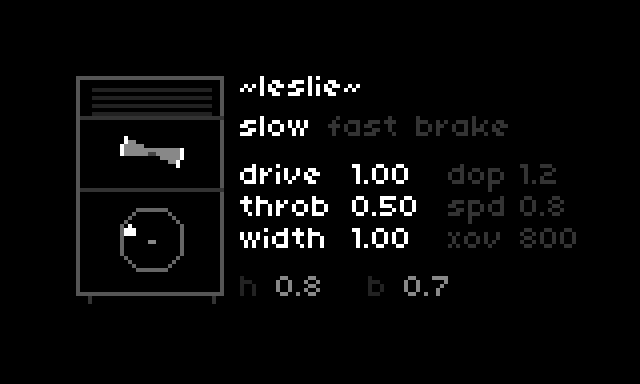
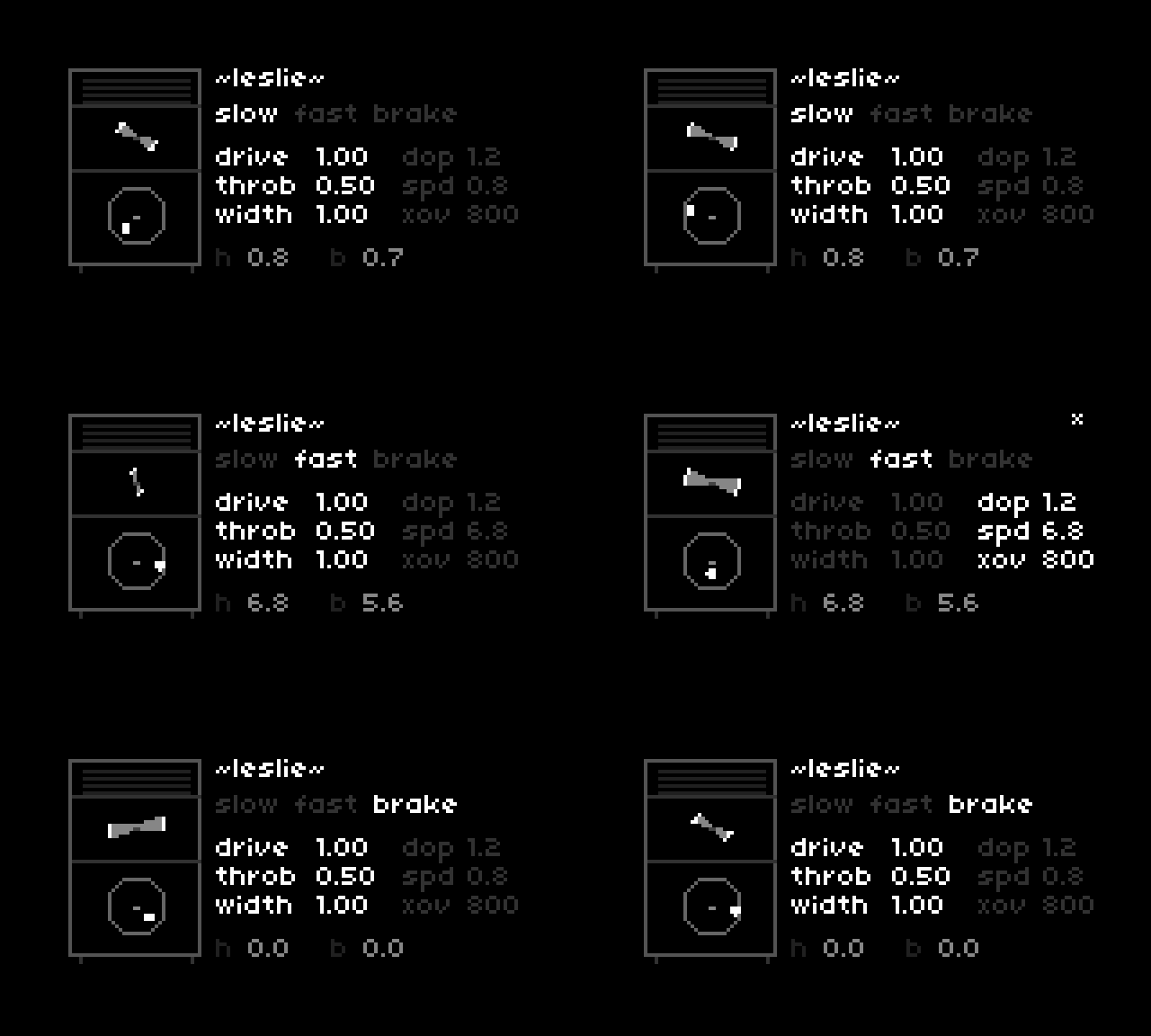
| Left (x 4–40) | cabinet — vent slats, horn rotor (bowtie of two flared bells), bass drum, legs |
| Title row | ~leslie~, with a * badge at the top-right corner while K1 is held |
| Mode row | slow / fast / brake — current mode at level 15, others dim |
| Param rows | left column = normal-mode params (drive, throb, width); right column = edit-mode params (dop, spd, xov). The active set is bright, the other dim, so all six values are visible at once. |
| Tach | h and b show the target rate of the current mode so the display reflects mode changes instantly. The on-screen rotors lerp toward that target with a per-rotor accel time, mirroring the engine's Lag.kr. |
The horn flare width modulates with abs(cos(angle)) so the bowtie thins to a line when end-on and opens back up when broadside, suggesting a vertical-axis rotation.
Signal chain
A single \leslie SynthDef in lib/Engine_Leslie.sc:
| Stage | What it does |
|---|---|
| input | sum stereo to mono, multiply by drive, soft tanh saturate |
| crossover | LR4 (cascaded LPF / HPF) at xfreq — sums flat, no magnitude dip at the split |
| rate smoothing | Lag.kr(hornRate, hornAccel) and the bass equivalent. brake is multiplied in after the lag, so engaging brake decelerates smoothly from whatever the current rate is and releasing it accelerates back. |
| LFOs | SinOsc.kr(hornCur) for the horn, SinOsc.kr(-bassCur) for the bass — counter-rotating |
| doppler | each band fed through DelayC.ar with delay time (lfo × dopp) + offset. The varying delay produces the swirling pitch shift. |
| AM | each band amplitude-modulated by its own LFO at 1 − depth/2 ± depth/2, so depth=1 swings between near-zero and full amplitude |
| pan | each band panned by its own LFO scaled by width. Because the bass LFO counter-rotates, the two bands sweep in opposite directions at independent rates. |
| mix | wet / dry crossfade |
Defaults track the Leslie 122: chorale 0.8 Hz horn / 0.7 Hz bass, tremolo 6.8 Hz horn / 5.6 Hz bass, crossover 800 Hz, horn accel 0.5 s, bass accel 1.2 s.
Install
From maiden:
;install https://github.com/moapacha/leslie
Or clone into ~/dust/code/leslie/ directly. The first load will compile the SuperCollider engine; if the engine does not appear, run ;restart in maiden to rebuild the class library.
Credits
The signal chain follows the architecture of mda Leslie (Paul Kellett, GPL), translated to SuperCollider for norns Crone. Defaults reference the Leslie 122 cabinet.
Hope you enjoy this script. Suggestions and contributions are welcome.